Last Updated: October 24, 2026
Quick Summary
A chiropractor for sports injury recovery assesses how your joints, muscles, and nervous system work together, then builds a plan to restore motion and reduce pain. Care does most of its work in the restoration layer, rebuilding range of motion and strength before you return to sport.
A chiropractor for sports injury recovery is a licensed clinician who assesses how your joints, muscles, and nervous system work together, then builds a plan to restore motion and reduce pain after an injury. At Clarendon Chiropractic, we treat that plan as one piece of a larger recovery picture, not a standalone fix.
Here is why that matters. A survey of Canadian national-team athletes found that 67% sought chiropractic treatment, and 81.3% of those who did named neck or back pain as their main reason (survey of Canadian national team athletes). That is a specific group, so do not read it as a U.S. adoption rate. It does show that athletes at a high level treat spinal care as normal recovery work.
Where does chiropractic fit? Think of your care plan as three layers:
Chiropractic care does most of its work in the middle layer. It also feeds information into the other two, because joint movement tells us how far along your recovery actually is.
What most guides miss is that a good sports chiropractor spends more time assessing than adjusting. The adjustment is the easy part. Finding out why your knee gave out in the third quarter is the work.
Sprains, strains, low back pain, neck pain, and joint restrictions after repetitive motion are the injuries we see most often in athletes. Chiropractic care does not replace orthopedic or emergency care for fractures, torn ligaments, or concussions. It handles the mechanical side of recovery.
Here is how that breaks down by injury type:
| Injury | What Chiropractic Care Addresses | Typical Starting Point |
|---|---|---|
| Low back strain | Joint restriction, muscle guarding | Movement assessment |
| Neck pain | Posture, segment mobility | Soft tissue work |
| Ankle sprain | Range of motion after swelling drops | Gradual loading |
| Runner’s knee | Hip and knee alignment | Gait and strength review |
| Shoulder impingement | Scapular and rib mobility | Overhead motion testing |
Almost 64% of respondents in a study of sports chiropractors reported currently treating professional athletes (study of sports chiropractors). Again, that describes the survey group, not every chiropractor in the country.
A common mistake is waiting until pain is severe. Athletes who get assessed early tend to keep small restrictions from turning into compensation patterns elsewhere.
Your first visit is mostly listening and testing, not adjusting. We take a health history, ask how the injury happened, and run movement screens to see what your body avoids.
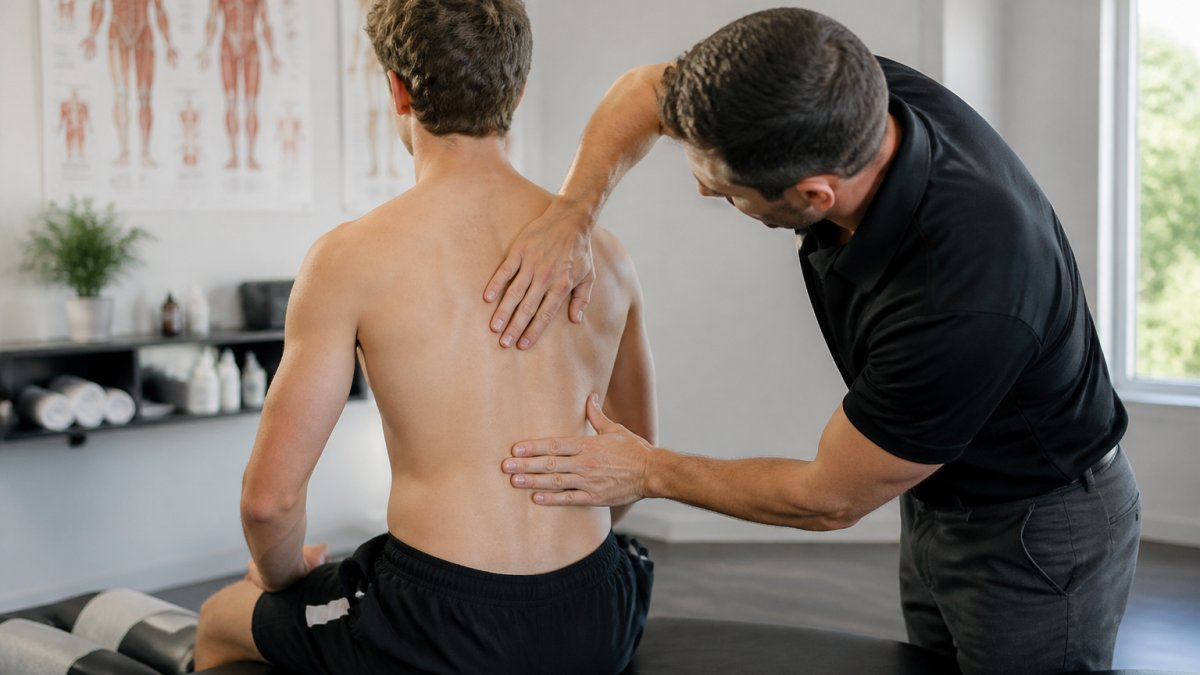
These manual adjustments often work in tandem with sports massage therapy to address lingering soft tissue tension and restore full range of motion.
Here is the general flow:
You should leave the first visit knowing what is wrong, roughly how long it takes to improve, and what you do between visits. You can also explore joint pain relief in Clarendon Hills for targeted care at the clinic. If a clinic cannot answer those three things, that is a signal.
Rehabilitation exercises are the part of recovery you control, and they matter as much as anything done in the clinic. Adjustments restore motion. Exercise teaches your body to keep it.
A useful weekly structure looks like this:
Athletes often ask whether in-clinic therapy or home exercise is better. The honest answer is that they solve different problems. If you want to compare the two, our article on posture correction therapy vs home exercises breaks down when each one earns its place.
What most guides skip: the exercises that help most are boring. Calf raises, single-leg balances, and slow tempo squats. Everyone wants the advanced drill. Almost nobody needs it in week two.
Most soft tissue sports injuries improve in stages measured in weeks, not days, and the timeline depends on tissue type, severity, and how consistently you do the work. Nobody can give you an exact date on day one, and anyone who does is guessing.
A realistic sports injury recovery timeline usually follows this shape:
| Phase | Typical Focus | What Progress Looks Like |
|---|---|---|
| First days | Calm symptoms, protect tissue | Pain settles at rest |
| Weeks 1-3 | Restore motion | Daily tasks feel normal |
| Weeks 3-8 | Rebuild strength | Load tolerance climbs |
| Weeks 8+ | Return to sport | Sport drills without setback |
Tracking progress objectively beats guessing. Our article on neurological testing explains how testing can show whether your recovery is actually moving, not just whether you feel better this week. Our article on neurological testing explains how testing can show whether your recovery is actually moving, not just whether you feel better this week.
Setbacks usually trace back to one cause: doing too much too soon. The athletes who recover fastest are rarely the ones who push hardest.
You are ready to return to sport when you can pass load tests, not when the pain disappears. Pain fading is a good sign. It is not clearance.
We look for four things before clearing an athlete:
Concussions need their own path, and objective testing helps. You can review pre and post concussion testing to see how baseline and follow-up testing guide that decision. You can review pre and post concussion testing to see how baseline and follow-up testing guide that decision.
The thing nobody tells you about return to sport is that the last 10% takes the longest. That is normal. Rushing it is how athletes end up back at week one.
Athletes add chiropractic care because it addresses movement quality, not just pain, and movement quality is what separates a full recovery from a recurring injury. A 2023 article recommends that sports-medicine policies and guidelines consider incorporating chiropractic care, though it reports no adoption rate or measured outcome (integration of chiropractic care into sports medicine).
What does that look like in practice? Three things:
Some athletes also want non-drug options alongside their care. Our article on therapeutic health alternatives for pain relief covers seven options that pair well with chiropractic treatment. Our article on therapeutic health alternatives for pain relief covers seven options that pair well with chiropractic treatment.
If you have tried chiropractic before and felt like you were cracked and sent on your way, ask better questions. Ask what the plan is, what you do at home, and how progress gets measured. The answers tell you everything.
Recovering from a sports injury takes a plan, not a single visit. If you are in the Westmont or DuPage County area and want care that looks at the whole picture, Clarendon Chiropractic combines chiropractic care with functional medicine and COREscore neurological testing to build a plan around your health history. Our team, led by Dr. Anthony Surrusco, focuses on root causes, personalized care, and guidance you can use between visits. Get started with Clarendon Chiropractic and a complimentary consultation to find out what your recovery actually needs.
Yes, chiropractors can be part of a sports injury recovery plan, especially for neck and back pain. A survey of Canadian national-team athletes found 67% sought chiropractic treatment, and 81.3% of those did so most often for neck or back pain. Care usually combines hands-on treatment with exercises and load management. A chiropractor should work alongside your other providers, and any plan should be based on an exam, not a guess.
Chiropractors commonly see athletes with neck pain, low back pain, muscle strains, and joint restrictions that limit movement. A survey of sports chiropractors found almost 64% of respondents reported currently treating professional athletes, which shows the scope of practice includes high-level sport. That said, not every injury is appropriate for chiropractic care. Fractures, suspected ligament tears, and neurological symptoms need medical evaluation first, so ask about the chiropractor’s experience with your specific injury.
See a chiropractor after a sports injury once you have a working diagnosis or if pain and stiffness are not settling within a few days. If you have severe swelling, cannot bear weight, heard a pop, or have numbness or weakness, get medical care first. For neck or back pain, athletes in the Canadian survey most often chose chiropractic care. Early care can help restore movement, but it should not replace emergency or orthopedic assessment when those are needed.
The choice depends on your injury and goals. Physical therapists focus on exercise-based rehab and load progression, while chiropractors often combine spinal adjustments with soft-tissue work and home exercises. Many athletes use both. A 2023 article in PubMed Central recommends that sports-medicine policies and guidelines consider incorporating chiropractic care, which suggests a team approach. Ask each provider how they will coordinate with the other, and pick the one whose plan matches your return-to-sport timeline.


